Taking Road Construction Digital — Holistic Solutions for Productivity, Quality, and Sustainability
SPONSORED CONTENT PRESENTED BY WIRTGEN GROUP
These solutions can help jobsites experience fewer delays, more efficient resource use, stronger documentation, and lower cost per unit of material laid.

In today’s infrastructure-world, nothing happens in isolation. Not the machines, not the workforce, not the documentation, and certainly not your budgetary and sustainability demands. In this environment, the move from traditional, machine-centric construction approaches towards fully integrated, data-driven production systems are no longer optional. It’s essential.
Luckily, digital-solutions are reshaping road-construction workflows, driving reliable productivity,
enabling real-time decision-making and unlocking a new class of process quality. Unfortunately,
our industry is slow to adopt change: for many reasons. But through Connected Support,
Jobsite Intelligence and Smart Automation, manufacturers are working to move their customers
and the industry forward.
Challenges Hinder Change
The road-construction sector faces multiple simultaneous pressures – which can put the
technology adoption process on the back-burner. Among them:
● A global shortage of skilled and qualified workers, especially machine-operators and
craftspeople.
● Escalating demands for documentation, traceability, and real-time transparency of work
output.
● Firm deadlines, tight margins and limited tolerance for rework or errors in mixed-use or
high-traffic zones.
● Growing sustainability and environment-compliance expectations (fuel efficiency,
emissions, material usage, logistics).
Those pressures though are the main reasons that construction firms cannot simply keep doing
what they have always done. Openness to connected machines, digital data flows and
automation becomes a competitive differentiator.
A Shift in Mindset
Rather than treating each piece of equipment as a stand-alone asset, the new vision is to treat
the entire jobsite as a production system. That means: machines, operators, materials,
processes, documentation, and service all linked in a unified ecosystem.
At the Wirtgen Group, this move from machine-centric to holistic project view is at the heart of
their digital strategy.
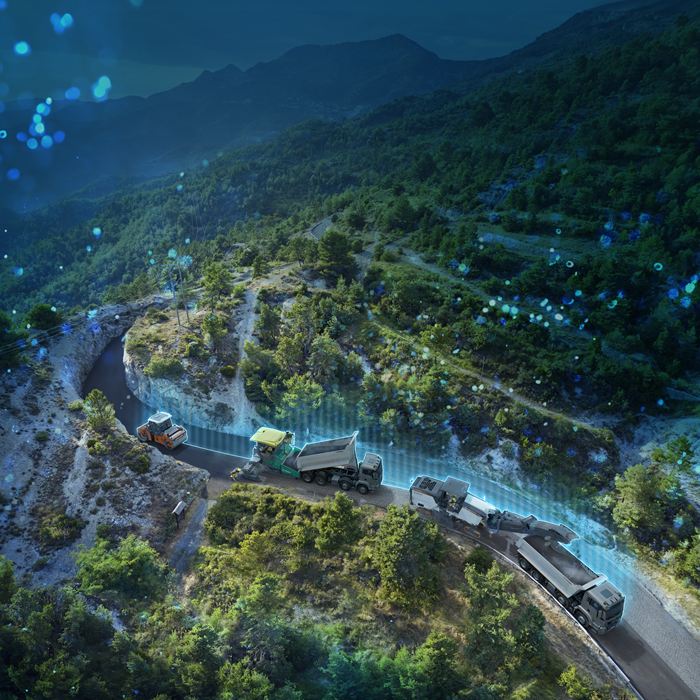
What does that look like in practice? Imagine an asphalt-laying project where the paver, feeders,
rollers, dump trucks, and the quality-control personnel are all connected via a digital backbone.
Data from each machine (location, status, material usage, cycle time) is collected and
visualised. Alerts and analytics inform dispatchers if a feeder is running low, a roller is idling, or
a section is lagging. Maintenance schedules are triggered proactively, not reactively. The result:
fewer delays, more efficient resource use, stronger documentation and lower cost per unit of road laid.
The Three Legs of the Digital Transformation Stool
In its road-construction digital-solutions ecosystem, the Wirtgen Group defines three
foundational pillars: Connected Support, Jobsite Intelligence, and Smart Automation.
Connected Support
- Real-time monitoring of machine status and health
- Service intervals and workshop processes integrated into digital workflows
- Alerting before failure, identification of issues fast, and planable maintenance / parts logistics
As the site-management world becomes thinner on experienced operators, the ability to keep
uptime high through digital support becomes a tangible competitive edge.
Jobsite Intelligence
Here the focus is on gathering, analyzing and acting on real-time data from the jobsite: machine
productivity, material flows, site logistics, and quality parameters. From this comes actionable
insight: where is the bottleneck, what machine run-rate is below target, which section is
underperforming?
This pillar enables dispatchers, site-managers and executives to switch from gut-feel judgments
to fact-driven decisions. Benefits to users will be maximized machine utilization rates, efficient
allocation of resources and timely project completion.
Smart Automation
With Smart Automation, the objective is to simplify operator tasks, embed assistance systems,
apply automation to key workflows, and, in time, shift towards autonomy. Elements include:
- Intuitive interfaces and assistance systems that reduce operator burden
- Automation of repetitive or precision-sensitive tasks (e.g., steering, width control, compacting parameters)
- Integration of machine functions into end-to-end workflows rather than stand-alone machines
This could look like the paver automatically controlling the width and direction using virtual
references and GNSS systems.
Here are some key examples of how the digital-pillars are put into action in the field:
- Performance Trackers (WPT): The Wirtgen Group’s Performance Tracker suite (e.g., WPT Milling, WPT Paving) documents actual work performed — such as milling depth, area covered, material removed — enabling accurate reporting and predictive planning. wirtgen-group.com+1
- Assistance systems for compaction (e.g., Smart Compact and Smart Doc): The Hamm Smart Compact system uses real-time measurement of material stiffness, cooling behaviour and drum settings to automate compaction settings. Smart Doc provides GNSS-linked visualisation and PDF reporting of compaction coverage and quality. wirtgen-group.com+1
- Automatic steering and width control for pavers: With Vögele, AutoTrac and Smart Pave allow the paver to use sensors and virtual references for automatic width/steering control, reducing operator workload and improving precision. wirtgen-group.com
- Fleet and site management platform: John Deere Operations Center™: The Wirtgen Group also uses the John Deere Operations Center (JDOC) platform as the hub for equipment and jobsite management: tracking machine condition, location, fuel usage, project progress — even mixed fleets from various manufacturers. wirtgen-group.com+1
Why Digital Tools Matter
For contractors and equipment-owners, the benefits of implementing digital solutions are
tangible and almost immediate:
- Higher productivity: less idle time, better utilization of machines, quicker decision-making
- Lower cost per ton: thanks to improved allocation, fewer delays, fewer reworks
- Stronger quality and documentation: digital records of what was done, when and how— valuable for owners and for compliance
- Better sustainability outcomes: through less fuel use, fewer passes, reduced material waste, improved planning
- Workforce enablement: digital systems help less-experienced operators perform at higher levels, reducing dependency on rare, highly skilled labor
For municipalities and infrastructure owners, the shift means enhanced transparency — they
can see progress, machine usage and quality in near real-time. This supports better lifecycle
planning and rebuild decisions, and aligns with sustainability and reporting demands.
Implementation: You’re Only As Good As Your Weakest Adopter
Rolling out digital solutions isn’t plug-and-play. Some thoughts for success:
- Start with clear objectives — e.g., reduce idle time by X %, improve compaction quality metrics by Y %.
- Ensure data-integration and compatibility — mixed fleets and legacy machines may add complexity; choose systems that support open platforms (e.g., JDOC).
- Train operators and staff — digital tools only succeed if people use them; change-management matters. Your company needs a digital champion that sees to it that the technology is being adopted and implemented and used on a daily basis.
- Use incremental rollout — pilot on one job site, refine workflows, then scale.
- Ensure owner/buyer alignment — if the infrastructure owner demands documentation or performance targets, build the digital layer to serve that.
- Consider maintenance and service — high-uptime digital systems are only valuable if machines stay running; tie in the connected-support pillar early.
- Measure ROI — track productivity gains, cost savings, quality metrics, fuel reductions to prove the case and guide further investment.
The Future Looks Digital
The path forward points to further automation and autonomy: fully unmanned machine
sequences, AI-driven optimization of process flows, real-time material quality feedback,
predictive analytics for entire job-site networks. Digital-transformation will also continue to
tighten the integration among machines, logistics, workforce and data-streams.
From the vantage of major equipment-system providers that have committed to this path, the
next wave is not just smarter machines, but smarter jobsites and smarter business-models.
Digital transformation in road construction is not simply about adding sensors or connectivity. It
is about re-thinking the entire production system: machines, operators, materials, logistics,
documentation and asset-management all aligned in a connected ecosystem. The three
pillars—Connected Support, Jobsite Intelligence and Smart Automation—provide the
architectural logic for this shift.
As the infrastructure world continues to demand higher quality, tighter schedules and stronger
sustainability credentials, only companies that leverage these digital levers will be able to keep
pace. For contractors, owners and equipment-providers alike, the race is on—those who move
early gain the advantage.
For further detail on specific digital solutions from the Wirtgen Group, see: Digital Solutions –
Wirtgen Group