
Pennsylvania explores antistrips for preventing moisture damage
While the original article was published in French, an English version of the article is below.
The following is an excerpt from a Bitume Quebec article submitted by the Pennsylvania Turnpike Association (PATP) in August 2025. The article was based on a three-year study the PATP did with the help of Penn State University looking into issues of stripping on field projects.
Moisture damage is a phenomenon that has plagued asphalt pavements since the early 19th century.
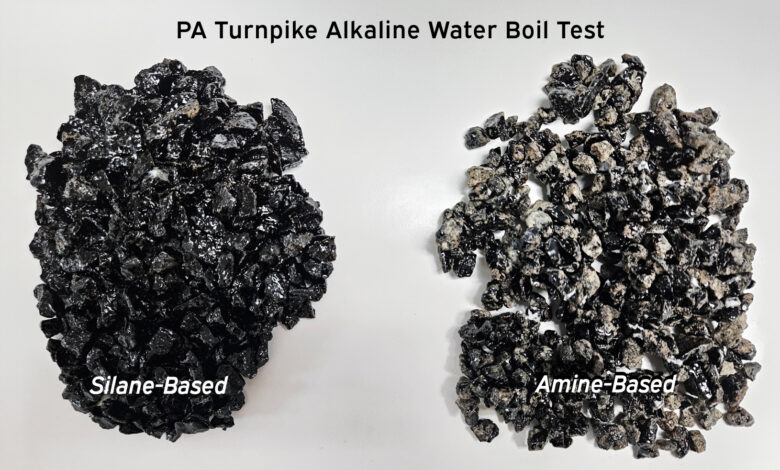
Water infiltrates the pavement, weakening the adhesive bond between asphalt binder (glue) and aggregate (load bearing particles). To prevent the loss of the adhesive bond, amine-based chemical antistrips have been used in Pennsylvania for nearly twenty years with mixed success.
Amines are derived from oleochemicals (e.g., vegetable oils and animal fats) and are among the most widely used additives in moisture damage prevention. As a cationic surfactant, the amines are absorbed into the surface of the aggregate creating a hydrophobic layer (repels water).
A new type of chemical anti-strip had been developed outside of the United States utilizing an organo-silane. Unlike amines which are absorbed into an aggregates surface, silanes chemically modify the aggregate surface by forming strong covalent Si-O-Si bonds. This chemical reaction creates a water-repellant layer that resists moisture infiltration.