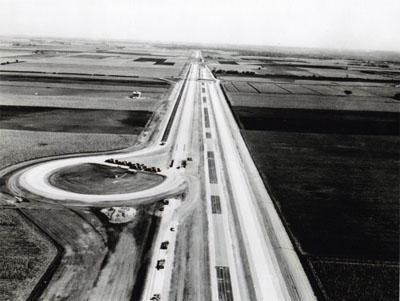
During this week’s episode of Pave It Black, Richard and Brett sit down with Dr. Marshall Thompson, professor emeritus at the University of Illinois Urbana-Champaign, and Kevin Burke, Executive Vice President of the Illinois Asphalt Pavement Association to find out how a stretch of Illinois highway has shaped how asphalt pavements are designed for nearly 70 years. Marshall, who visited the road test firsthand as a University of Illinois undergraduate, walks through the origins of the project and its influence in anchoring present-day AASHO pavement design guides.
Kevin brings the Illinois Asphalt Pavement Association’s perspective on what it meant for the state to host research with this kind of lasting national influence. Both guests connect the road test’s legacy to modern mechanistic empirical design, fatigue endurance limits, and the future of pavement research.
Here’s a sneak peek into this week’s conversation but be sure to tune in to the full episode for all the insights. You can listen wherever you get your podcasts.
RW: Marshall, thinking back to times you’ve been in the classroom teaching pavement design, what do you think is important for students to understand about the road test and how it impacts what we do today, or how it got us to the point where we are today?
MT: One thing is the concept of the present serviceability index, which was developed at the road test. Obviously, you can’t have enough people go out and visually consider all those sections or assign a value to each. So they took a group of experts, looked at a whole bunch of pavements in existence, and rated them on a scale of five down to one or zero, five being the best, and developed an algorithm for estimating the PSI. So PSI emerged from the road test, and all the design schemes presented after that were based on that particular measure of, quote, “pavement performance.”
KB: Getting that real-world, field-practical knowledge is critical to becoming a pavement engineer who can understand and fix problems once they’re out in the field, because the best design can be undermined if we don’t construct it with good quality construction and good quality materials.