
A Smarter Approach to In-Place Recycling and Stabilization
How the latest generation of cold recyclers and stabilizers combines mixing performance, operator assistance and digital documentation to help contractors deliver more consistent results.
For asphalt contractors and road asset owners, rehabilitation decisions increasingly come down to a familiar set of pressures: improve the existing roadway, control costs, reduce material movement and keep projects progressing efficiently.
In-place recycling and stabilization can address those priorities by treating existing materials where they are, rather than relying solely on removal and replacement. But the value of the process depends on more than production alone. Consistent mixing, accurate operation and repeatable results are what turn a recycling or stabilization strategy into a dependable construction method.
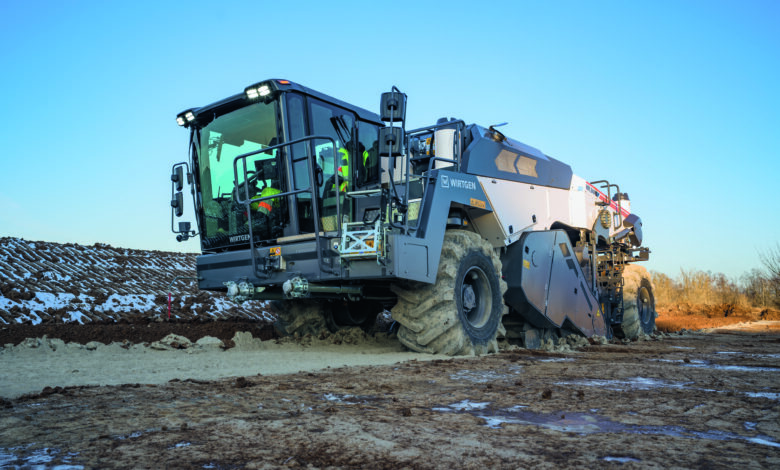
That is where the newest generation of Wirtgen X-Tier cold recyclers and stabilizers is designed to move the process forward. The machines combine updated milling and mixing technology with a redesigned operator environment, digital assistance and project documentation tools. The result is a platform built not only around hp, but around helping crews manage the entire process more consistently from one pass to the next.
Matching the Machine to the Application
Cold recycling and stabilization processes cover a broad range of work, so there is no single machine configuration that fits every job. Instead, machines should give contractors options based on production requirements, working depth, transport needs and the material being processed. The Wirtgen Group created options to tackle any job contractors may encounter.
The WR 200 X is the most compact model in the core WR lineup. With a maximum working width of 7 ft.10 in., working depth up to 20 in., and maximum power of 429 hp, its lower operating weight and compact dimensions are intended to make transport between projects easier. That can be especially useful for contractors moving frequently among smaller or dispersed jobs.
For contractors looking for a balance between machine weight and output, the WR 240 X provides a maximum working width of 7 ft.10 in., a working depth up to 20 in., and maximum power of 610 hp. It is positioned as the versatile, high-production machine in the range for both cold recycling and stabilization work.
At the upper end of the core series, the WR 250 X is built for applications where maximum power and production reserves are the priority. It offers a maximum working width of 7 ft .10 in., a working depth up to 22 in., and maximum power of 755 hp.
Across the WR series, the machines are designed for applications ranging from cold recycling and structural road rehabilitation to soil stabilization and consolidation. That flexibility allows contractors to select a machine around the job instead of forcing the job around a single machine.
For contractors seeking additional versatility, the Wirtgen W 380 CRi offers the ability to perform both high-performance cold recycling and conventional milling operations. With a maximum working width of 12 ft. 6 in., milling depths up to 12 in., and 1039 hp, the machine can be configured for high-output milling using the up-cut process, making it well suited for large-scale pavement removal projects, including highways and airport runways.
Its powerful milling and mixing system also allows contractors to recycle existing asphalt materials in place, incorporating binding agents to create a new, homogeneous pavement layer. This dual functionality provides contractors with greater flexibility to tackle different rehabilitation applications with one machine, helping maximize equipment utilization and expand project opportunities.
Consistency Starts at the Rotor
In-place recycling and stabilization also require a machine to do more than break up material. The goal is to produce a homogeneous mixture across the working width and depth so the treated layer can perform as intended.
The latest WR generation uses an improved DURAFORCE milling and mixing rotor that is designed to maintain mixing quality and productivity under changing working conditions while also addressing fuel consumption, emissions and wear.
For contractors, that consistency matters because field conditions are rarely uniform. Material composition, moisture and load-bearing capacity can change as the machine advances. A system that supports consistent processing can help crews maintain the target result while reducing the amount of operator intervention needed to respond to every change.
Reducing Operator Workload With Digital Assistance
One of the biggest changes in the X-Tier generation is inside the cab. The revised operating concept includes a multifunction joystick, fingertip controls, an adjustable multifunction armrest and a large machine-control display. More importantly, the interface is designed to help the operator understand what the machine is doing and what action should come next.
The Wirtgen Group CoPilot digital assistance system provides interactive recommendations and tutorials directly through the machine display. The system can guide operators through functions and process steps, recognize operator inputs and machine status, and then move to the next step in the sequence. For experienced operators, that can provide quick support when switching applications or settings. And for newer operators, it can shorten the learning curve by putting machine-specific guidance in the cab.
Meanwhile, MIX ASSIST on these machines adds another layer of automation. Operators can configure automated functions and save sequences of working steps for later use. The display can also prioritize the camera view that is most relevant to the current work step. Rather than asking the operator to continually manage every individual function, the system is designed to make repeatable processes easier to execute.
Additional assistance features include AutoTrac steering, which follows a calculated reference strip with a specified overlap, and Automatic Reverse, which allows the operator to reverse travel direction at the push of a button. Together, these functions are aimed at reducing repetitive workload while supporting accurate, efficient operation.
Turning Jobsite Activity Into Usable Documentation
Digital assistance is increasingly valuable not only during production, but after the machine has completed the pass. Wirtgen Performance Tracker or WPT records relevant construction parameters with positioning data and compiles them into a field report.
For contractors and owners, that creates a clearer record of what occurred on the project. Instead of relying only on handwritten notes or separate reporting processes, crews can document machine and construction data as the work is performed. As project specifications and quality expectations continue to evolve, that type of documentation can help support transparency, quality control and more informed conversations between contractors, agencies and project stakeholders.
Purpose-Built Options for Specialized Work
The X-Tier platform also extends beyond conventional recycling and stabilization. The WRS 240 X is based on the WR 240 X platform but incorporates a 5.5-m³ binding-agent spreader for dust-reduced application of materials such as lime or cement. The integrated design is intended for applications where controlling dust is especially important, including work near residential areas, industrial sites, freeways or environmentally sensitive locations. Its all-terrain mobility also supports spreading on soils with low load-bearing capacity.
For projects involving coarse rock, concrete fragments or stony material, the WRC 240 X takes a different approach. The machine combines crushing and homogeneous mixing in a single pass and can process rock or fragments with uniaxial compressive strengths up to 200 MPa. Wirtgen reports production rates up to 600 tons per hour, depending on operating conditions. Water and binding agents can also be incorporated during the same pass, allowing the processed material to be prepared for applications such as base-layer construction.
The Bigger Opportunity: More Control Over the Process
The evolution of recycling and stabilization equipment reflects a larger change in road construction. Productivity remains critical, but contractors are also being asked to deliver greater consistency, document their work and make the most of a workforce that may include operators with very different levels of experience.
The Wirtgen X-Tier generation of cold recyclers and soil stabilizers addresses those needs by bringing machine performance, operator guidance, automation and documentation into one platform. The technology does not replace the experience of a skilled operator or the importance of proper mix design and project planning. Instead, it gives crews additional tools to execute the plan consistently.
For asphalt contractors evaluating in-place recycling or expanding an existing stabilization operation, the question is no longer simply how much material a machine can process in a day. It is how effectively the machine can help the crew control the process, adapt to the application and document the result. That combination of production and process control is where the next gains in recycling and stabilization are likely to come from.