
Benchmarking Burner Rates Adds Relevance to EPD Data

Report establishes a framework for understanding the differences between fuel consumption rates at asphalt plants
The following is an excerpt from Thermo-Dynamic Based Framework to Determine Mix-Specific Burner Fuel Consumption Rates at Asphalt Plants.

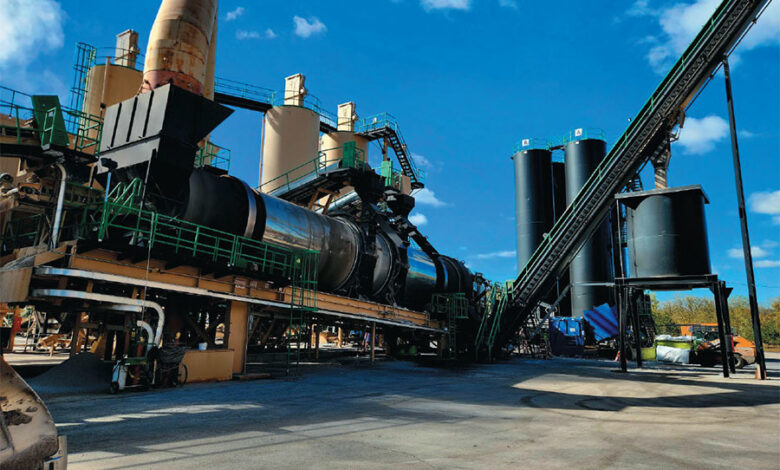
Asphalt mixtures are produced by drying and heating aggregate and reclaimed asphalt pavement (RAP) particles, followed by mixing with asphalt binder at a specified mix temperature to ensure a proper coating. Virgin aggregates and RAP material enter the dryer drum at ambient temperature with varying moisture contents resulting from production, storage, and local weather conditions. The heat generated by the dryer burner is used to dry and heat both virgin aggregate and RAP. Burners consume various types of fuel, including natural gas, propane, and diesel. Drying the aggregate and RAP requires a considerable amount of energy to turn the water into steam. Once the particles are dry, further heating brings them to the mixing temperature.

Several key mixture-related factors influence burner energy consumption at an asphalt plant. One key factor is the mix temperature: Higher mix temperatures require more energy to heat the material to the desired mix temperature, leading to increased energy consumption. Additionally, the aggregate and RAP stockpile moisture contents can also impact energy consumption, as more energy is required to evaporate the moisture from the material.
BURNER ENERGY REQUIREMENT AT AN ASPHALT PLANT

Several plant-related factors can also impact energy consumption, in addition to mixture-related factors. One such factor is the insulation of dryer shells. An insulated dryer drum experiences less heat loss to the environment through radiation from its outer shell, known as “casing loss,” compared to an uninsulated or partially insulated drum. Several past studies have assumed the casing loss to be approximately 5-10%. However, this percentage is specific to a particular plant and not a constant across different plants.
NAPA introduced an environmental product declaration (EPD) program in 2014 to establish a standardized method for assessing the environmental impacts of asphalt pavement products. The EPD program has recently published updated product category rules (PCRs) on which the EPD program is based. The PCR requires 12-month average energy consumption data from manufacturers (A3), including electricity and burner fuel consumption, for producing one short ton/metric ton of asphalt mixture. It also requires mix-specific data for raw material inputs (A1) and transportation distances (A2). Therefore, the EPD program cannot account for changes in mix-related factors, such as mix temperature, stockpile moisture, and stack gas temperature, among others. In other words, if a plant manufacturer develops EPDs for two asphalt mixtures, one at 300°F and the other at 260°F, the production stage (A3) impacts will be the same for both mixtures, even though WMA consumes lower burner fuel, which is not reflected in the EPD. Therefore, there is a need to develop a reliable and easy-to-implement approach to determine the burner energy/burner fuel consumption at an asphalt plant that can estimate temperature-dependent burner energy consumption.
OBJECTIVE & SCOPE OF WORK

The objective of this study was to develop a thermodynamics-based methodology for estimating temperature-dependent burner energy and fuel consumption at asphalt plants, with explicit allocation of burner energy based on the production temperature of the asphalt mixture, and to validate the proposed methodology using field-measured burner fuel consumption data.
The scope of this study included the following tasks:

- Development of a thermodynamics-based framework to estimate burner energy and fuel consumption at asphalt plants for any mix production temperature of interest using known plant-specific energy and operating information. This framework is formulated based on the thermal equilibrium of key processes occurring at asphalt plants, including:
- Drying and heating of virgin aggregate and reclaimed asphalt pavement (RAP)
- Heat losses associated with exhaust (stack) gases
- Casing heat losses resulting from plant start-up and shutdown
- Radiative heat losses from plant components during operation
- Validation of the proposed framework using field-measured burner fuel consumption data from asphalt plants operating at both hot-mix asphalt (HMA) and warm-mix asphalt (WMA) temperatures. Burner fuel and production data from 10 asphalt plants were used for the validation.
- The scope of the work also included a stakeholder survey of producers across the United States to understand the availability of data needed for the practical implementation of the proposed methodology into the EPD program.
FRAMEWORK DEVELOPMENT: THERMAL PROCESSES AT AN ASPHALT PLANT

Thermal processes at the dryer drum of an asphalt plant involve drying and heating virgin aggregate and RAP to the desired mix discharge temperature using a dryer burner. The dryer burner energy required (btu/ton) for these thermal processes at an asphalt plant can be calculated using a simple thermal equilibrium equation.
Published in December 2025 and coauthored by the National Center for Asphalt Technology’s Surendra Chowdari Gatiganti and Benjamin F. Bowers, Thermo-Dynamic Based Framework to Determine Mix-Specific Burner Fuel Consumption Rates at Asphalt Plants is accessible from the NAPA Resource Center.