
Rieth-Riley partners with Strong Vets to support job-seekers
This article appears in the Fall 2025 print edition of NAPA Quarterly. Subscribe here.
TY JOHNSON
EDITORIAL DIRECTOR

Born into a military family, young Michael Pitz was reminded of the opportunity to serve when his career National Guardsman father returned home at the end of each workday.
“Seeing him coming home every day in uniform was my biggest inspiration,” Pitz said. “I also have a very large military family,” listing off a half-dozen family members that have worn the uniform, dating back to his great-grandpa in World War II.
Learn more about Strong Vets and supporting veterans.
Pitz joined the National Guard while he was still in high school and after graduation he sought a job where he could work hard, like his dad had always told him.

presents Area Manager Brian Carlson with
the Patriot Award.
“I was looking into jobs that were more physically demanding, so I was a mechanic, but I didn’t do it very long before I found Rieth-Riley,” he said. “A labor-demanding job has kind of always enticed me just because I can’t sit down. I start getting restless if I’m sitting down for too long.”
Working in Rieth-Riley’s quality control lab in Indianapolis, Pitz found a work culture where his schedule with the Guard was no problem, as well as a manager so accommodating that Pitz nominated him for an award based on his support of citizen warriors.
Pitz’s experience at Rieth-Riley is just one example of the employee-owned company’s flexibility around hiring veterans and others affiliated with the military. It’s so important that Rieth-Riley Superintendent Jon Holman is working to make hiring practices at Rieth-Riley and companies across a host of other industries even more military friendly.
“If I can get veterans plugged into these good companies, they’re going to be in a lot better position, financially and mentally, than I was when I got out.”
– Rieth-Riley Superintendent and Army Veteran Jon Holman

THE HOME FRONT
Lately, Holman has been overseeing a lot of roundabout installations in the region that surrounds Indianapolis, not far from where he grew up.
“We handle asphalt in Indianapolis and the surrounding communities, so we cover a pretty big radius,” he said.
Within that radius lies Carmel, Indiana. With at least 150 roundabouts, it’s earned a reputation as the nation’s roundabout capital. Based on Rieth-Riley’s project schedules, that total will continue to increase.
“This year and next, we’re installing three more roundabouts and reconstructing the road, so we’re doing new storm pipe, installing some new water services, walking paths — a complete reconstruction,” Holman said. “They love roundabouts here.”
But there was a time when Holman felt like he was at an intersection himself.
“About the only time I’ve been away from Indiana was the military,” he said, explaining that he joined the Army and was an active-duty infantryman from 2006 to 2009, stationed at Fort Lewis, near Tacoma, Washington. He served 15 months overseas, mostly in Iraq.

“Not everyone is going to be career military and stay in for 20 or 30 years,” he said, fast-forwarding to when he re-entered civilian life. “And I struggled. I got out and I was looking around for jobs.”
Holman worked the third shift as a security guard at a hotel in downtown Indianapolis making $8 an hour to support his three kids.
“It was very tough to try to make ends meet. I mean, it was pretty much impossible,” he said, explaining how he took a job in the plumbing industry running tools for $9 hourly. He expanded his knowledge and skills until he was running crews by day, then knocking on doors in a polo and dirty jeans to advertise those sewer services to neighbors.
With newfound foreman experience, Holman went into earthworks and briefly owned his own business on his winding career path that brought him to Rieth-Riley two years ago.

As a company with an Employee Stock Ownership Plan (ESOP), Rieth-Riley stood out among the job offers he received.
“Rieth-Riley, being ESOP, was the one that was most appealing because that creates more of a family culture,” Holman said. “It’s like ‘We’ve got to look out for each other. This is all of our future.’ Bottom line for all of us is if we do better, if we’re more efficient, and we put in good quality work, then we’re all going to grow together.”
It’s a benefit of working at Rieth-Riley that Pitz does not take for granted, either.
“When you’re working with any ESOP company, the employees care more because what they do impacts the company, which in return impacts your retirement status,” Pitz said.
“The construction industry and trades are the best place for somebody who works hard and is willing to start at the bottom to achieve top positions,” Holman said. “Me starting as a laborer and now being a superintendent: There’s not a whole lot of areas where you can do that, but the construction industry is different. You have a lot of on-the-job training and you can get exposure to a lot of different things. It’s the best industry because if you work hard you can rise to pretty much any level.”
Holman said the general public’s view of road construction, especially, often gets oversimplified, with the hard work and discipline involved overlooked.
“People think that we’re just out here building roads, but they don’t truly understand how complicated these projects can be,” he said, adding there is sometimes a stigma associated with the industry that can impact recruitment. “We are surrounded by so many incredibly smart, hardworking people who have to be cut from a different cloth to be able to survive in this type of industry.”
BECOMING A STRONG ADVOCATE FOR VETS

For Holman, Rieth-Riley was his first exposure to the asphalt pavement industry, and the paving offseason gave him an opportunity to devote more time to his volunteer work. Holman worked to meet the qualifications to become a certified personal trainer to help veterans devote their free time toward productive activities. He also gives his time to multiple veterans organizations, including as an advocate for veterans in his home county who find themselves overwhelmed trying to navigate the court system.
“I’m a veteran mentor for Johnston County, which is the county I live in,” he said. “Veterans who are going through hard times sometimes make it into the court system, and I walk alongside them as a veteran mentor to help guide them and talk to them and give them an outlet to keep them on the right track.”
Between the veterans he encountered through his mentorship and others he talked with through Veterans Ministry or heard about from out of state, Holman began to wonder if there was another approach to getting veterans acclimated to civilian life that was missing.
“Right or wrong, doing the mentor program and just living through it, I saw that it’s really easy to get hooked on drugs or hooked on the bottle,” Holman said. “And I thought if we could do something where we get great companies to partner with us so we could help place veterans into these companies, then they won’t have to struggle the way that I struggled when I got out.”
From that concept, Stong Vets was born.
COMMITTING TO CARE FOR VETERANS
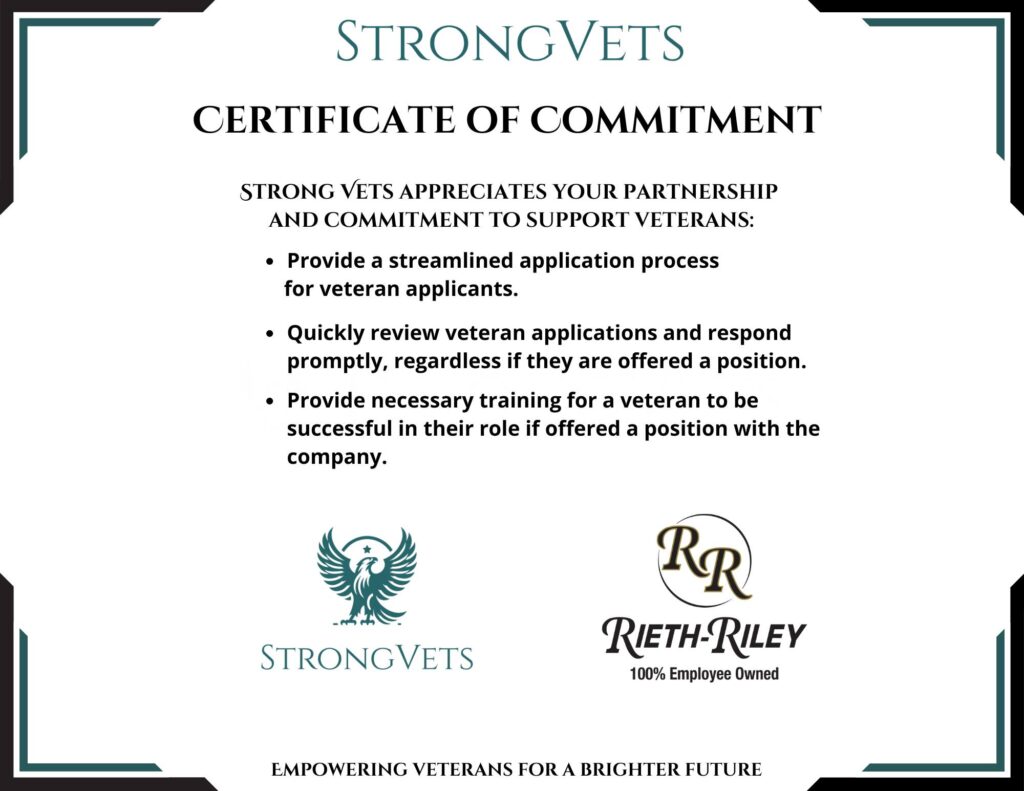
Companies that partner with Strong Vets, like Rieth-Riley, make a commitment to three hiring principles as part of their support for military hiring:
- Provide a streamlined application process for veteran applicants.
- Quickly review veteran applications and respond promptly, regardless of whether they are offered a position.
- Provide necessary training for a veteran to be successful in their role if they are hired.
In addition to Rieth-Riley, Strong Vets has partnered with companies in logistics, equipment sales, and machine rentals, bringing together a coalition of businesses offering gainful employment that have pledged to ease the hiring process for veterans entering the civilian workforce.
“Strong Vets exists to see veterans grow professionally, physically, and spiritually,” Holman said. “If I can get veterans plugged into these good companies, they’re going to be in a lot better position, financially and mentally, than I was when I got out.”
In its partnerships, Strong Vets asks companies to commit to three hiring practices.
“The first ask of any company that partners with us is that they streamline the application process for veterans, so if they see it’s a veteran applicant, they can push it to the top and review it,” Holman said. “The second is that, upon review and regardless of if they’re going to offer an interview or not, they contact the veteran. Give them the respect to say ‘We don’t think this is a good fit.’ And the third thing is, upon hiring a veteran, providing them with the necessary training and resources for them to succeed in their role.”
In founding Strong Vets, Holman tapped other veterans, including disabled veterans, to serve in leadership roles and on the organization’s board of directors. His vice president and secretary both served multiple combat tours. All saw the latest generation of veterans struggling with some of the same issues they had faced when they returned from active duty.
So far, Strong Vets is reaching veterans through word of mouth, with Holman sharing the opportunity with veterans organizations in his area, including the joint post near his house that hosts members of both the Veterans of the Foreign Wars of the U.S. (VFW) and the American Legion. While the effort is largely focused on veterans in Indiana, the group is still in its infancy and aims to expand its base as its partnerships grow.
“We post on our website homepage who our partners are and if you click on the link it takes you to all the job postings that company has,” Holman said, adding that means he can just direct veterans he meets with to Strong-Vets.com. “That way, when I speak with them I can say ‘Check out any of those companies and if you like them, let me know and we’ll help get your resume together and get you linked up with them.’”
As the organization and partnerships grow, Holman said Strong Vets will explore ways to support veterans beyond the hiring process. The group will be pursuing grant funding to bring new resources to the veteran community, including a venue with gym facilities and meeting rooms.
“Anything else that they can look to that will help keep them on the right track. They can reach out to us as a resource to help plug them into the right groups. The big thing is we don’t want to turn anybody away,” Holman said. “Veterans — they need help. I think it’s good to get people together to try to help those who are willing to serve and give us the life that we have now.”
HIRING FOR MOTIVATION AND INTELLIGENCE
When hiring, Rieth-Riley Vice President of Central Indiana Scott Stine said he hears plenty from applicants about their job experience, but often he is seeking the answers to two questions. “Are they motivated and are they intelligent? If they are motivated, they will work hard for you. If they are intelligent, they will learn.”

Both of those attributes are found among the military community, Stine said. By identifying veterans and those affiliated with the military, he has found workers who can handle the realities of construction work while they are gaining skills on the job.
“If you’ve been in the military, you’ve gone through basic training,” he said. “You understand there’s going to be some difficult moments. There’s going to be some easy days, too, but the values of the individual just match up well. There’s a chain of command as to how things get done and who reports to whom and how we move and communicate.
“A lot of things the military holds paramount among its operations fit construction companies, too. They are oriented in a similar fashion, but with different titles.”
“[The construction industry] is the best industry because if you work hard you can rise to pretty much any level.”
– Rieth-Riley Superintendent and Army Veteran Jon Holman
Stine said Rieth-Riley’s approach received the best kind of endorsement when the Department of Defense’s Employer Support of the Guard and Reserve presented Pitz’s manager, Brian Carlson, with the Patriot Award. Pitz nominated Carlson for the award based on his support during Pitz’s leaves of absence from work. The award recognizes managers who support citizen warriors through flexible schedules, time off before and after deployment, and other measures.
Pitz said while laws and regulations already stipulate how companies should handle work absences for drills, scheduling and arranging for someone to cover your shift sometimes weighs you down.
“Jobs in the past have made it seem like it was my burden to hold when I had to go to drill. As if it was a bad thing that I had to leave to go training,” he said. “But with Rieth-Riley, I’ve never felt negative about having to leave.” That includes when he deployed to Africa for nine months and Rieth-Riley agreed to match his salary during his time overseas.
Stine said there was no hesitation from Rieth-Riley when Holman asked if the company wanted to partner with Strong Vets, for two reasons.

“First, they’ve been successful in their first career and now that’s over and they’re looking to enter the marketplace. They go through an interview process just like anyone else, but we’d be first in line to give those ladies and gentlemen an opportunity to enter the construction market. These veterans, they’re not kids anymore. They have done their duty and we’d be glad to have those qualified folks on staff.”
Rieth-Riley’s second reason? Holman himself, who embodied the capability of veteran employees even before he set out on his Strong Vets venture.
“If Jon’s going to recommend them, then we’re going to do our best to find a place for them, just like the military,” Stine said. “If it’s not a fit with us, we know a lot of different subcontractors and suppliers. We can help them find their way, because getting a good job is not necessarily what you know – obviously motivation and intelligence matter – but it’s sometimes about who you know and how to get properly connected.”