Download the Industry’s New Reference for Roads and Runways
COMPILED BY ARA
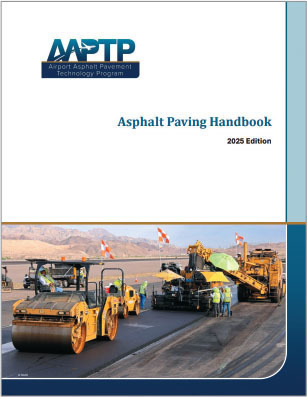
For the first time in 25 years, the asphalt paving industry has an updated reference that reflects today’s technologies, methods, and best practices. Produced through the Airport Asphalt Pavement Technology Program (AAPTP), a cooperative agreement between the Federal Aviation Administration (FAA) and the National Asphalt Pavement Association (NAPA), the new handbook offers comprehensive guidance for roadway and airfield paving.
The handbook, developed by the Asphalt Institute and reviewed by NAPA, FAA, the Federal Highway Administration (FHWA), the U.S. Army Corps of Engineers (USACE), contractors, and suppliers, reflects broad industry consensus and incorporates more than two decades of advancements in materials, mix design, equipment, and quality assurance practices.
“The new handbook gives our industry a shared reference point – engineers, contractors, inspectors, and owners are all working from the same playbook,” said Richard Willis, NAPA’s vice president for engineering, research, and technology. “That consistency strengthens communication, builds collaboration, and ultimately delivers better-performing pavements.”
Unlike the 2000 edition, the new handbook places greater emphasis on airfield paving. It includes direct references to FAA P-401 and the USACE UFGS 32 12 15.13 specifications, the two primary standards governing U.S. airfield projects. In addition, it addresses airfield-specific challenges such as segregation, joint construction, and compaction – critical factors that directly affect pavement safety and long-term performance.
“This handbook is more than just an update – it’s a unifying reference point for both highway and airfield paving,” said Asphalt Institute Vice President of Engineering Mark Buncher. “It brings the entire industry onto the same page with practical guidance that’s field-ready and rooted in the latest research.”
“As we developed this edition, we kept the focus on the practical aspects that have the greatest impact on pavement performance,” added Danny Gierhart, director of engineering and training at the Asphalt Institute. “That’s why you’ll find call-out boxes, checklists, and step-by-step guidance throughout – tools designed for real-world use in the field.”
The handbook includes practical checklists for every stage of the paving process. Plant personnel can confirm readiness with lists covering material handling, cold feed, binder heating, and equipment calibration. Paving crews get best-practice checklists for placement and paver operations, while compaction chapters include roller-specific checklists for steel-wheel and pneumatic rollers. These tools make it easy to double-check critical steps and keep projects on track to achieve quality results.
The handbook doesn’t just explain best practices – it shows them. Embedded links connect readers directly to more than 30 short training videos that bring key topics to life, from paver operations and roller techniques to joint construction, segregation control, and smoothness requirements. These clips, each only a few minutes long, make the handbook not only a reference to read but also a tool that brings topics to life – turning guidance into practical, on-site demonstrations.
Many stakeholders in the asphalt industry may not realize how different airfield paving is from highway paving. The performance demands of runways and taxiways – from load repetition to smoothness – require stricter standards and practices. While the new handbook remains a broad paving reference, it now helps bridge this gap by including FAA and USACE specifications and guidance on critical topics like compaction, joint construction, and segregation.
The Asphalt Paving Handbook is available as a free digital download. An interactive website and mobile app are also in development, ensuring the handbook’s guidance will be even easier to access in the future. Learn more at AirportAsphalt.com.