
Dunn & won
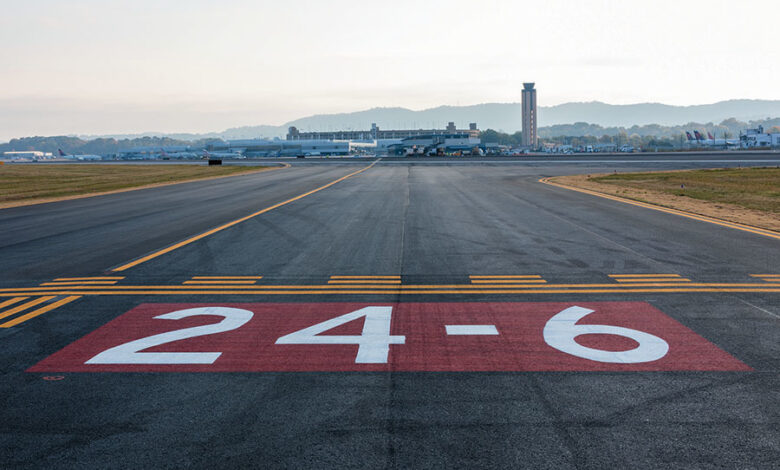

Dunn Construction’s work at Birmingham Airport in Alabama earned the 2025 Ray Brown Airport Award.
NAPA presented the 2025 Ray Brown Airport Asphalt Pavement Award to Dunn Construction Co. Inc. of Birmingham, Ala., for their work on Taxiway H Connector at the Birmingham-Shuttlesworth International Airport (BHM) in Birmingham, Ala.
“Airports are vital to the nation’s infrastructure and require uncompromising precision,” said NAPA 2025 Chairman Pat Nelson. “The Ray Brown Award recognizes a project of superior engineering that ensures flawless safety and performance.”
The award recognizes the highest-scoring airfield asphalt paving project in the nation among submissions to the Quality in Construction (QIC) Awards.
It honors Ray Brown, who was the director of the National Center for Asphalt Technology (NCAT) at Auburn University from 1991 to 2007. Under his guidance, NCAT became renowned for its asphalt pavement research.
Because it was a reconstruction, the work at the Birmingham airport was phased into four Taxiway H connectors, which were treated as four small, self-contained contracts to reduce operational impact and simplify staging.
“To keep the paving train running, we planned detailed run sequences, pre-staged equipment and materials, and optimized haul cycles so P-401 mix arrived at placement temperature. The mix came from our Tarrant plant about four miles from the airport,” Dunn Vice President of Operations Hector Orozco said.

Work crews met specifications with the airfield paving at the Taxiway while dealing with the tight scheduling windows that come standard with active airports. Operations were restricted to nightly midnight to 4 a.m. windows when the taxiway was closed “to provide a safe work zone while keeping daytime runway activity.”
Besides scheduled commercial passenger service, corporate and private aviation, and air freight operations, the field also hosts an Air National Guard refueling wing, so all construction and flight scheduling is coordinated with the Guard to preserve operational readiness.
Dunn used profile milling to achieve Federal Aviation Administration (FAA)-required cross slopes and each phase included quality assurance and quality control checks: milling profiles, slope verification, compaction/density testing, and mix temperature logs.
Although the project included initial delays, continued coordination with stakeholders allowed Dunn to resolve any conflicts without delaying the overall schedule.
After final walkthroughs demonstrated the work met or exceeded expectations, the decision was soon made to submit for the award. When Dunn leadership received word of the win, they shared the news companywide via email and the company’s internal app, and passed word along to the Birmingham Airport Authority.
“The field crews and office staff responded with pride — they appreciated being recognized for work done under tight windows and complex constraints,” said Orozco.

