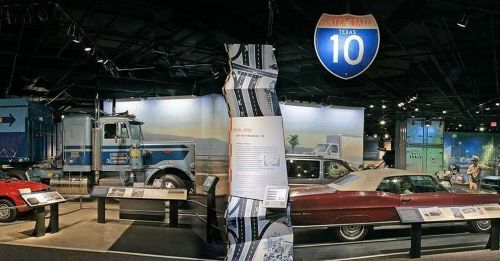
How does a slab of asphalt end up inside the Smithsonian? In this episode of Pave It Black, NAPA veterans Peter Wilson and Ron White explain how the asphalt pavement industry became part of the National Museum of American History’s America on the Move exhibit, a look at transportation’s role in shaping the country.
The conversation traces the industry-led effort behind the exhibit: a fundraising campaign that raised roughly a million dollars, the engineering challenge of producing a finished asphalt sample at a Virginia paving plant and transporting it intact to Washington, D.C., and the installation itself, precision-cut steel frames and all.
Here’s a sneak peek into this week’s conversation but be sure to tune in to the full episode for all the insights. You can listen wherever you get your podcasts.
RW: So when you look at this exhibit, it’s trying to shape transportation not just as an isolated technology, but as something that shaped America. How does asphalt fit into that role?
RonW: Oh my gosh — quite frankly, without asphalt, we wouldn’t be where we are in America today. It has created so many opportunities in so many states, communities, and jurisdictions. Without asphalt, you wouldn’t have what we have today in either the urban or suburban environments that exist.
There are things it creates in our economy that open up opportunity across the economic board, and it’s been nice to watch our communities do what they’ve done over the years. Keep in mind, asphalt is 95% of the construction industry compared to other uses for road systems. So without us, I’m not sure what the environment would be, or what our communities would be.
RW: Is there a special story that’s a good memory when you think about that experience?
PW: Believe it or not, I enjoyed the fundraising part. I enjoyed getting out with our members — we raised a million dollars, and you think about how many $100,000 contributions you get, how many $50,000 contributions, how many $20,000 contributions. Going out and working with all of our members, explaining the Smithsonian project, what it meant for our industry, what it meant for us, what it could mean for you as a company — almost everybody stepped up. It wasn’t that difficult, believe it or not, to raise the money once we were able to tell our story. I enjoyed that. I enjoyed getting to know our members even better.