AAPTP resources reach new heights
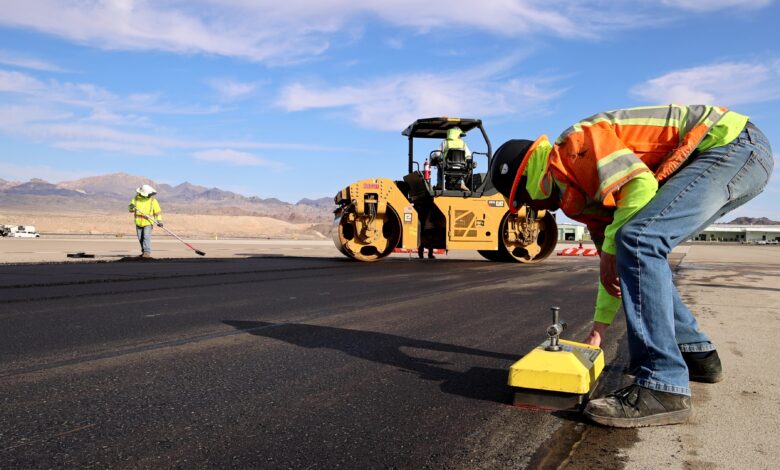
New research advances airfield pavement testing

The Airport Asphalt Pavement Technology Program (AAPTP) released two new research reports this spring offering updated technical guidance to improve the performance, safety, and durability of asphalt pavements at the nation’s airfields.
The findings give engineers and contractors new tools for testing, design, and construction at airports nationwide.
The two studies address compaction method validation for asphalt mix design and the prevention of pavement slippage failures at high-speed runway exits.
VALIDATING GYRATION LEVELS FOR ASPHALT MIX DESIGN
New research confirms that both the traditional Marshall hammer and the modern Superpave Gyratory Compactor (SGC) can produce comparable results for airport asphalt mix design, giving agencies and contractors a reliable baseline for using either system. The study also provides practical guidance for organizations transitioning to newer compaction equipment.

Researchers from the National Center for Asphalt Technology (NCAT) at Auburn University and the University of Nevada, Reno, conducted the work to support the Federal Aviation Administration’s stringent materials and construction requirements.
“Although this research has been done before, the results have never been robust enough to implement,” said Dr. Richard Willis, NAPA Vice President of Engineering, Research, & Technology. “We wanted to establish a reliable baseline that would allow complementary designs using both the Marshall hammer and the SGC and ultimately make the results practical to adopt.”
PREVENTING SLIPPAGE FAILURES AT HIGH-SPEED EXITS
A second study identifies the key causes of pavement slippage failures near high-speed runway exits – zones where aircraft rapidly transition from landing speeds to taxiing – and equips airport engineers with improved tools for pavement design and construction. Findings address interface delamination, shear-stress ratio thresholds, and temperature sensitivity.
Researchers from Rutgers University, NCAT, and Arizona State University investigated how unstable mixtures, weak interlayer bonding, temperature conditions, and construction practices contribute to these failures.
“As an engineer and a professor, I always enjoy solving practical problems,” said Dr. Hao Wang, civil and environmental engineering professor at Rutgers University. “This project gave us an opportunity to apply our knowledge to real-world issues and contribute to aviation safety.”
DEMYSTIFYING PAVEMENT DESIGN & PERFORMANCE
Putting a new shine on the asphalt pavement industry’s time-tested best practices is no small task.
NAPA and Applied Research Associates (ARA) teamed together with stakeholders, companies, and individuals across the country to chronicle the approaches, procedures, and specifications that help shape the nation’s road network.
The collaboration, part of the AAPTP, involved thousands of research hours and hundreds of interviews, and produced a video series and dozens of articles.

New resources include:
- A new edition of the Asphalt Paving Handbook, which provides comprehensive technical information and best practices related to the paving of asphalt mixtures for roadway and airfield projects. While prior editions focused on roadway paving, the 2025 edition includes insights on practices unique to airfield work.
- The Asphalt Airfield Video Series, showcasing content from the Asphalt Paving Handbook to help practitioners design, produce, and construct airfields for the FAA.
- Fact sheets that break down larger resources exploring validating gyration levels, balanced mix design, binder selection, slippage failure prevention, and longitudinal joints into short, easy-to-digest summaries.
Access these reports and more at AirportAsphalt.com.

ABOUT AAPTP
The Airport Asphalt Pavement Technology Program (AAPTP) is a cooperative agreement effort between NAPA and the Federal Aviation Administration (FAA) to advance asphalt pavements and pavement materials.
The AAPTP advances solutions for asphalt pavement design, construction, and materials deemed important to airfield reliability, efficiency, and safety. The program leverages NAPA’s unique technology implementation capabilities with assistance from the FAA and industry to advance deployment and adoption of innovative asphalt material technologies.