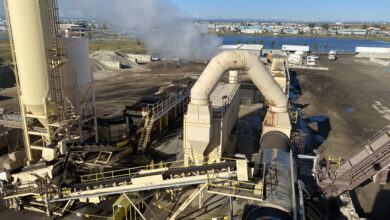
Framework lets producers capture WMA fuel savings in EPDs
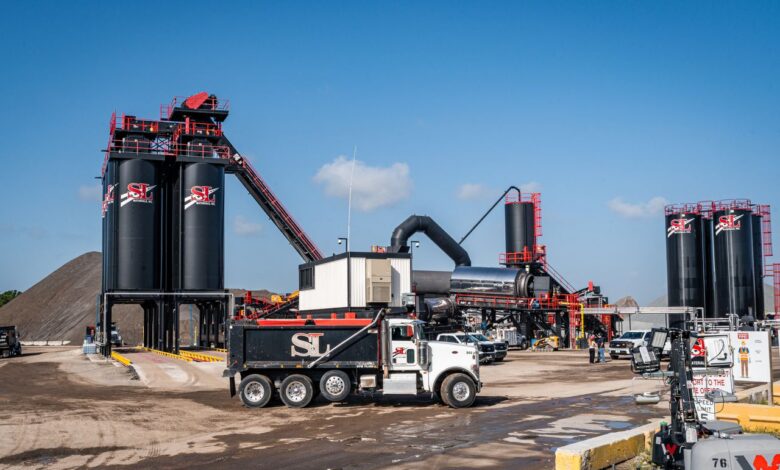
A report from NAPA gives producers a practical way to reflect the fuel savings of lower-temperature mixes in their Environmental Product Declarations (EPDs) — a benefit that current reporting methods overlook.
Access the report from the NAPA Resource Center.
Published in June 2026, SIP-112: A Thermodynamic Based Framework to Determine Mix-Specific Burner Fuel Consumption Rates at Asphalt Plants addresses a longstanding gap in how the industry accounts for burner energy.

Under today’s Product Category Rules, EPD programs report burner fuel consumption as a 12-month plant average. As a result, warm mix asphalt (WMA) and hot mix asphalt (HMA) produced at the same plant carry identical production-stage (A3) energy impacts — even though warm mix, produced at lower temperatures, consumes meaningfully less fuel. The environmental advantage of running cooler simply does not show up in the numbers.
Authored by National Center for Asphalt Technology (NCAT) researchers Surendra Chowdari Gatiganti and Benjamin F. Bowers, the study develops a thermodynamics-based method to allocate burner energy according to a mix’s actual production temperature. The framework is built on the core thermal processes at an asphalt plant — drying and heating virgin aggregate and reclaimed asphalt pavement (RAP), stack gas heat losses, and casing losses — and estimates how fuel use changes as production temperature changes.
Crucially, the approach relies on data that plants already collect. Using routine annual-average plant information and established thermodynamic relationships, it estimates temperature-dependent fuel consumption without continuous monitoring or added instrumentation.
The researchers validated the framework against field-measured burner fuel data from 10 asphalt plants producing at both hot mix and warm mix temperatures, drawing on measurements from this study along with data from the NCHRP 9-47A project and guidance from industry across multiple states and plant configurations. The model predicted warm mix fuel consumption with a mean absolute error of 5.3% and a root mean squared error of 5.9%, and performed consistently across parallel flow, counter flow, and batch plant types with no systematic bias by drum type.
SIP-112 was produced with support from The Road Forward Partners.
A companion nationwide stakeholder survey — with responses from 169 asphalt plants across 29 states — found that most of the required inputs, including burner fuel consumption, production tonnage, mix temperature, and mix design information, are already available at most plants. Where plant-specific composite stockpile moisture data are unavailable, the report recommends a default value of 3.2%, noting that reasonable variation in moisture changes the estimated fuel reduction by no more than ±3%.
Download SIP-112 free at AsphaltPavement.org.
The report recommends adopting the framework to incorporate temperature-dependent burner energy allocation into asphalt mixture EPDs, giving producers a credible, low-effort way to document the environmental benefits of warm mix.