Senators Unveil Broad Permitting Reforms, a Longstanding NAPA Priority
A bipartisan group of senators unveiled a permitting reform package that, if enacted, would be a sweeping overhaul of the federal permitting process and the most impactful permitting law in years.
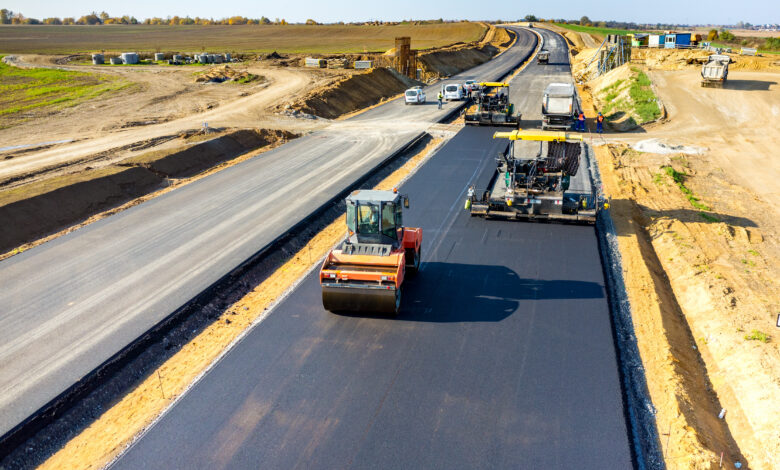
The Bipartisan American Affordability and Jobs Act (BAAJA) would affect a wide range of sectors, including the electric grid, renewable energy, and construction. For the asphalt pavement industry, the bill would streamline permitting, reduce delays, and provide greater certainty for projects.
“Our industry has long urged Congress to address delays caused by the cumbersome permitting process, and the Bipartisan American Affordability and Jobs Act would do just that,” said Nile Elam, NAPA Vice President of Government Affairs. “By speeding up project delivery and providing greater certainty, this bill would benefit the asphalt pavement industry and every community that relies on a first-class road network.”
Bipartisan Bill Introduced After Long Negotiations
After months of negotiations, BAAJA was introduced Sept. 30 by Sens. Mike Lee (R-UT), Chair of the Energy and Natural Resources (ENR) Committee; Shelley Moore Capito (R-WV), Chair of the Environment and Public Works (EPW) Committee; Martin Heinrich (D-NM), ENR Ranking Member; and Sheldon Whitehouse (D-RI), EPW Ranking Member.
“After years of work in Congress and many months of negotiations, I’m proud we’ve reached a bipartisan agreement to fix this broken process and get America back to building,” Lee said in a statement.
“Like all major pieces of bipartisan legislation, this bill is a compromise,” Whitehouse added. “We believe it is a compromise that will result in a brighter, cleaner, more affordable future.”
A range of industry groups, environmental organizations, congressional caucuses, and think tanks have endorsed the bill.
The senators hope to take up the bill in early November, after the midterms, though opposition is already emerging. House Natural Resources Committee Ranking Member Jared Huffman (D-CA), whose committee would have jurisdiction over parts of the bill, issued a statement opposing it.
“Folding our hand now or in the lame duck makes no sense when we can keep working on this and, in a few more months, have a much better deal that works for everyone,” Huffman said.
A Closer Look at the Permitting Package
BAAJA seeks to speed up permitting and provide greater project certainty while preserving environmental review.
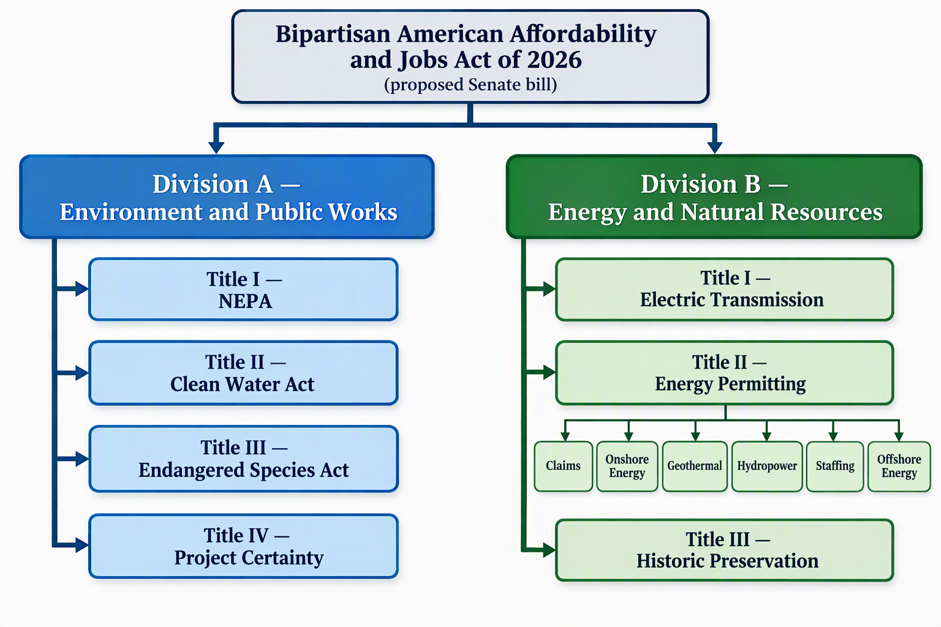
The 417-page bill contains seven titles organized into two divisions. It addresses environmental reviews, water and wildlife protections, and project certainty, as well as electric transmission, energy permitting, and historic preservation.
Some highlights include provisions that would:
- Revise the National Environmental Policy Act to establish clearer deadlines, improve coordination among federal agencies, and narrow the range of projects requiring more extensive environmental reviews.
- Streamline Clean Water Act permitting, establish deadlines for filing certain legal challenges, and extend the terms of some permits.
- Accelerate Endangered Species Act reviews and exempt certain activities within existing transportation rights-of-way.
- Strengthen project certainty by restricting federal agencies’ ability to rescind, suspend, or materially alter permits, subject to specified exceptions.
NAPA continues to analyze the bill’s provisions and their potential effects on the asphalt pavement industry. For additional details, Holland & Knight published a brief overview and a section-by-section summary.
A Longstanding Priority for NAPA
Permitting reform has long been a priority for NAPA, which has urged Congress to reduce delays, streamline project approvals, and give states and contractors greater certainty as they plan transportation improvements.
Over the past year, NAPA has supported the SPEED Act and PERMIT Act, both of which passed the House, as well as the bipartisan CERTAIN Act introduced last spring. Those efforts reflect a consistent goal: a permitting process that allows needed infrastructure projects to move forward efficiently while maintaining environmental protections.
NAPA has also advocated for permitting reforms through the BUILD America 250 Act, the House’s five-year surface transportation reauthorization bill. Its permitting provisions underscore the importance of pairing long-term infrastructure investment with a more efficient process for getting projects approved and built.
With BAAJA and the BUILD America 250 Act, two widely bipartisan proposals, Congress has an opportunity to deliver transformative change for the asphalt pavement industry and the communities it serves, a story NAPA will continue to share with lawmakers.
“With surface transportation reauthorization and permitting reform both demanding action, Congress has a critical window to deliver lasting improvements to our roads and the way we build them,” Elam said. “We strongly urge lawmakers to get this bill and the BUILD America 250 Act across the finish line.”